
✅ This article contains no plot spoilers — it's world history and geography. Read on.
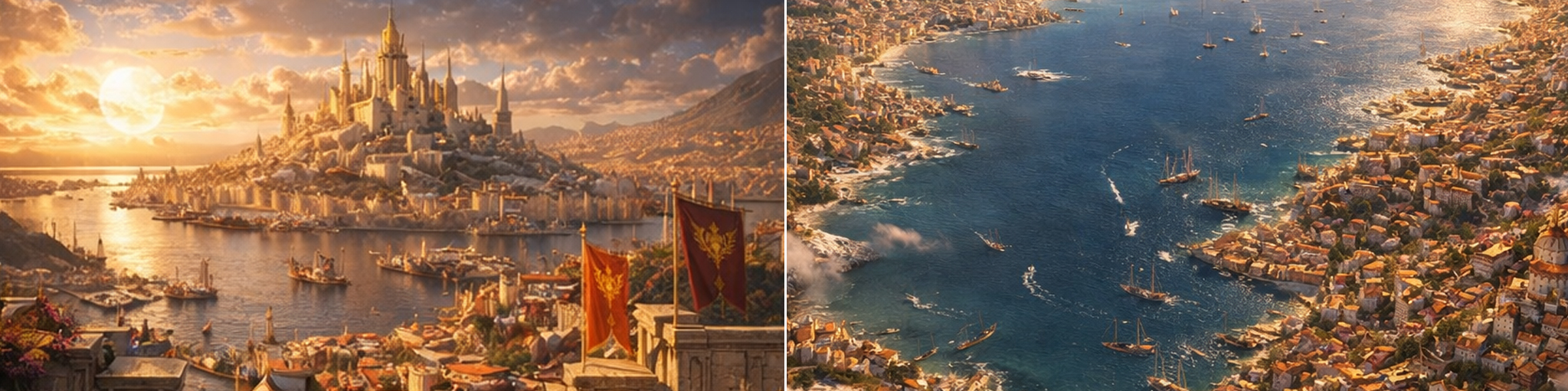
The Midland Empire is the dominant political power of the surface world, controlling the majority of inhabited lands along the shores of the Inner Sea — the great inland body of water that forms the heart of the known world, called the Nostrum in older Imperial verse and formal address. From its capital Maritana, set deep within a sheltered bay on the northern coast, the Empire's territories extend roughly two thousand miles in both the westward and southward directions along the coast — four thousand miles of shoreline in total — and approximately fifteen hundred miles inland to the north before the land rises into the Hill Country. The climate throughout is warm and generous: long dry summers with abundant sunshine, mild and occasionally wet winters, and spring and autumn seasons of exceptional clarity. The Inner Sea moderates extremes in both directions — coastal winters rarely bite hard, and summer heat is tempered by the sea breeze that locals call the maestral, which rises each afternoon off the water and renders even the hottest months liveable. Snow is a curiosity on the coast, a rarity even in the interior provinces, and a reliable event only in the Hill Country beyond the Empire's northern edge.
It is the largest and most complex human state in recorded history, governing a patchwork of provinces, vassal kingdoms, and allied nations so diverse in language, custom, and creed that no single description fits them all. What holds them together is not shared blood or shared faith — both exist in abundance and constant tension — but shared interest. The Empire is, above all else, an economic organism. It sits between the Sky Realm above and the Netherworld below, trading with both, dependent on neither, and indispensable to both. This position has made it wealthier than any purely surface power in history. It has also made it a permanent target.
The name was chosen deliberately. "Midland" implies all surface territory between the deep and high realms — which is to say, everywhere. The full imperial title — Empress of All Midland Realms — has never been disputed aloud by any power capable of disputing it.
The Inner Sea forms the Empire's natural heart and its most valuable asset. The coastal cities that ring it are its wealthiest provinces, and control of its trade routes has historically been the measure of imperial power. Islands scattered across the Nostrum serve as strategic outposts, resupply stations, and in some cases, semi-autonomous communities with their own distinct cultures absorbed into the imperial fold over centuries.
To the north, the coastal plains give way to a region of rolling low mountains known as the Hill Country, inhabited by tribal peoples the Empire collectively terms Barbarians — a label that says more about Imperial attitudes than about the tribes themselves, who maintain complex societies and long memories. The Empire has fought them, bribed them, and occasionally suffered serious losses to them. It has never fully conquered them, and has largely concluded that doing so would cost more in blood and coin than any northern territory is worth. The preferred policy is containment: keep the tribes divided, monitor their movements, and ensure no single chieftain becomes powerful enough to unite them. In the early years of Empress Maren's reign, one nearly did. He is not remembered fondly in the hill country.
Beyond the Hill Country, the mountains grow taller and the land wilder, eventually becoming impassable peaks and, beyond those, territories that no Imperial expedition has meaningfully mapped.
To the west, the imperial border meets the Wild Baron Lands — nine independent baronies that refused Imperial suzerainty when the Empire expanded westward, and have maintained their independence, with varying degrees of conviction and economic dependence, ever since. Their rulers are officially termed Wild Barons; within the Empire they are more commonly called Barren Barons, a pun that has never gone out of fashion. The baronies permit non-Conclave magic and faiths banned within the Empire, which Imperial citizens find alarming and Wild Baron subjects call freedom. A thorough account of their character, their politics, and their relationship with the Empire — including the mutual system of prejudices both sides have developed over generations — can be found on the Wild Baron Lands page.
To the southwest, across the southern reach of the Inner Sea, lies Gorth — an ancient land of ruins, small princedoms, and nomadic tribes. It is what remains of the great overseas empire that the first Emperor Galenus destroyed five centuries ago when founding the Midland state. The civilisation he shattered was old even then, its cities magnificent, its history long. What survives is fragments: crumbling monuments, feuding successor states, and populations that have not forgotten what was taken from them. Gorth poses no immediate threat. If a strong ruler were ever to unite its factions, the calculation would change.
To the east, the fertile lands of the Empire's eastern provinces eventually give way to the Expanse — a vast open steppe stretching southward and eastward for distances that no Imperial geographer has reliably measured. It is inhabited by nomadic tribes in constant motion and occasional violent competition for fertile ground and water. The Empire's relationship with the Expanse is complex. Most of it lies beyond Imperial control or interest. One significant exception exists: the Rulen, a warrior people who entered the Empire's eastern borders several generations ago and, rather than being expelled or destroyed, were absorbed under terms that suited both parties. The Rulen pay taxes and contribute soldiers to the Imperial military when called upon. In exchange, the Empire provides them protection from rival steppe peoples — a significant benefit in a region where raiding and tribal warfare are constants. The Rulen are governed by their own War Cult, a martial faith that venerates the Empress as the greatest living warchief and regards the Empire as the mightiest war-engine in the world. This belief is, by most measures, accurate.
For most of recorded human history, magic was a thing to be feared rather than used. Practitioners existed in every generation — hedge-witches, tribal shamans, necromancers, self-taught wanderers who had stumbled onto some fragment of power — but their arts were weak, unstable, and deeply mistrusted. No codified theory existed. No institution governed practice. Magic passed from teacher to student in secret, or was reinvented imperfectly by isolated individuals working without guidance. The results were as often catastrophic as useful. Most people avoided magic users entirely, and few rulers welcomed them at court.
This began to change approximately seven hundred years ago, in a minor barony in what is now the Maritana province.
The details are disputed, as details from seven centuries past tend to be. What the historical record agrees upon is this: a group of practitioners gathered at the court of a local baron and began, for the first time, to treat magic not as an art or a mystery but as a science. They wrote the first systematic treatises. They established incantation codices, described the rules governing artefacts, catalogued effects and their causes. They argued, tested, revised, and argued again. What emerged from these years of work was the discipline now called Mind Magic — structured, controlled, reproducible, and orders of magnitude more powerful than anything that had come before.
The four scholars most credited with this work are known to history as the Theoreticians. Their names survive in Conclave records, though they are rarely spoken outside scholarly circles. Their memory is revered by the mage orders to this day.
When the baron who had hosted them attempted to conscript their abilities for his military campaigns, he discovered his mistake. The Theoreticians had trained disciples. Their disciples had trained more. The practitioners who had arrived at his court as useful curiosities had become, quietly and without announcement, more powerful than his army. They left. He sent soldiers after them. The soldiers did not come back.
The battle on the slopes of the mountain where the mages made their stand is considered the founding moment of Mind Magic as an organised force. On that site, the Theoreticians built Arcani — a city of stone and scholarship, set high enough to be defensible and wealthy enough, within a generation, to be virtually impregnable. It stands to this day.
Over the following decades, Arcani accumulated power at a pace that alarmed those paying attention and astonished those who were not. Only Arcani produced trained mages of any serious capability — and serious magical capability, it turned out, translated directly into wealth, military advantage, and political leverage. Rulers who wanted access to any of those things needed Arcani's cooperation. Most eventually concluded that cooperation was preferable to the alternative.
What emerged over roughly a century was what Imperial historians call the Magocracy: a proto-empire centred on Arcani, governing an expanding territory through a combination of magical superiority, economic control, and the implicit threat of what happened to the baron who had tried to march soldiers up that mountain.
It lasted approximately one hundred and fifty years. It was not a happy period for those who lived under it.
The Archmages carried within their institution a weakness they could not see clearly enough to correct: contempt. Their term for non-magical people was profanes — the uninitiated, the lesser, those who did not and could not understand. This was not merely a private attitude. It shaped governance, taxation, law, and the daily experience of living under mage rule. The profanes noticed. Resentment accumulated slowly, then faster, then in the form of open rebellion.
The Magocracy's second structural weakness was numerical. Magical training required years, innate talent, and individual instruction. A baron with a grudge could arm five hundred peasants with spears in a fortnight. He could not produce five hundred trained mages in a lifetime. The mages could defeat almost any military force they faced — but "almost" contained multitudes, and the defeats were expensive in ways they could not easily recover from. When Gorth launched a major invasion from across the Inner Sea, and the hill tribes of the north raided simultaneously, the Magocracy repelled both. The strain nearly broke it.
The challenge that ultimately ended the Magocracy came not from armies but from a religious movement.
The Imperial Creed — known in those years simply as the Creed — proclaimed a doctrine that cut directly against everything the Magocracy represented: that magic was impure, that righteous power came from moral integrity and martial discipline, that the so-called profanes were not lesser but simply uncorrupted. Its priests wielded no magic of their own. What they carried instead were a collection of artefacts of wholly unknown origin, whose nature and history have never been satisfactorily explained.
Among these Sovereign Relics were items capable of things no trained mage could counter: the Eye of the Sovereign, a medallion that could completely suppress the magical abilities of any person in its presence; the Brand of the Sovereign, whose function Creed records describe only obliquely; and several others whose properties remain classified within the Bishop council's archives. Critically, the Relics could also grant a degree of magical immunity to those the Creed chose to protect. Against opponents who could be rendered powerless at close range, the Archmages' greatest advantage became unreliable.
The last decades of the Magocracy were a grinding, inconclusive civil war between the mage orders and the Creed's growing coalition of barons and common adherents. Neither side could deliver a decisive blow. The Archmages could not be destroyed outright; the Creed could not be suppressed while its Relics made its leaders magically untouchable. The territory between them was exhausted and burning.
Into this stalemate came a stranger.
He arrived from beyond the northern mountains, from somewhere in the frigid territories no Imperial expedition had mapped, leading perhaps five hundred warriors. They were not a large force by any reckoning that mattered in that war. What they were was exceptional — each of them a seasoned fighter, and all of them bound to their chieftain with the kind of loyalty that is not purchased or conscripted but chosen, repeatedly, over years of shared survival.
His true name was not pronounceable in any dialect of Middlish. He called himself Galenus — a word from an old form of the language meaning one who comes from afar. Where he came from, he never clarified, and his descendants have maintained the same studied vagueness on the subject ever since.
The Imperial account holds that he crossed the northern mountains out of territories no expedition had mapped. His five hundred warriors, when pressed in later years, spoke of a cold land far to the north, beside a sea that appeared on no Imperial chart. They would say nothing further. Galenus had forbidden it, and their loyalty to him on this point — as on all others — held without exception.
The Wild Barons offer a different account, and advance it with considerable relish. Nothing lies beyond the highest northern ridge, they say, but a deadly cold desert of snow and ice. No man walks out of that wasteland with five hundred warriors at his back. Their version: Galenus was a hill tribe chieftain, exiled from whatever cave he called home, whose talents were real but whose origin was considerably less romantic than Imperial legend requires. It is not an entirely implausible theory. It also does not explain where a hill tribe exile acquired the instincts of a statesman, the eye of a strategic genius, and the particular quality of loyalty he inspired in men who followed him across half a continent and kept his secrets for the rest of their lives. Unless he was simply a natural-born wonder — which Imperial tradition has always preferred to believe, and which the Wild Barons have never offered a better alternative to explain.
In the Imperial year 197, during a period of relative peace with the hill tribes, the Emperor Estrus dispatched an expedition over the mountains to seek the ancestral homeland. The explorers returned two years later, greatly reduced in number, sick and exhausted. Their report was brief: no passable route existed over the highest ridge. From what summits they reached, they had seen nothing to the north but white wasteland extending to the horizon. No further serious attempt was made. The Empire had grown up facing the sea. The sea was where its ambitions lay.
His entry into the war began with a single act: he intercepted and destroyed a mage ambush that would have killed one of the Creed's senior bishops. Whether by intelligence, coincidence, or something else entirely, no account specifies. The bishop survived. Galenus gained an alliance.
Over the following decade he built a coalition — the Creed, whose leadership recognized in him a military commander they could not produce themselves; several barons who swore personal loyalty to him, impressed by his battlefield record and his unusual talent for negotiation; and a growing number of ordinary people who wanted the war to end on almost any terms. He fought campaigns, made deals, and demonstrated consistently that he was difficult to outmanoeuvre and nearly impossible to intimidate.
In the late summer of a year now commemorated as the Empire's founding date, approximately five hundred years ago, Arcani fell.
Many among his coalition demanded total extermination — every mage killed, the art itself outlawed, Arcani razed. Galenus refused. He executed the sitting Archmages, the inner leadership of the Magocracy who had prosecuted the war. Then he ordered the surviving mages to elect new ones immediately, and presented those newly elected Archmages with a choice: swear eternal loyalty to the throne he was about to establish, or face the extermination his allies were demanding. The mages accepted.
The Conclave was founded that same year, its oath of loyalty to the Imperial throne written into its founding charter. The Imperial Creed became the state religion. The Sovereign Relics were secured in a vault beneath the Creed's main cathedral in Maritana, accessible only to the Bishop council — a physical guarantee, built into the foundations of the new order, that the mages' power could always be checked. Galenus understood, or had been advised, that leaving the Creed and the Conclave in permanent tension with each other and permanently dependent on imperial authority to resolve that tension was not merely a political arrangement. It was a structural feature.
The Empire at its founding: five barons, two allied kings, one state religion, one oath-bound mage order, and one emperor standing at the centre of a storm he had spent a decade carefully constructing.
Galenus named his dynasty De Valoren — meaning, in the old form of Middlish, one of valour. When asked why, he is recorded as having said that one had to be brave to rule all this. The remark was apparently made with a smile. Whether it was a joke or a warning, his descendants have been finding out ever since.
The Empire at its founding was modest by the standards of what it would become: five barons, the Creed, the Conclave, and two allied kings. Over the following generations it expanded steadily — seven more barons joined or were absorbed, a third kingdom was added, the Rulen were incorporated under their special arrangement, and the Trade Republic of Lunara negotiated its complex association. Each addition brought new complexity to an already intricate structure, and each was managed, or mismanaged, according to the quality of whoever sat the throne at the time.
The five centuries between Galenus's founding and the present have not been peaceful, but they have been, by the standards of the world, relatively coherent.
The Empire expanded in the generations following the founding, absorbing additional baronies and their neighbours through a combination of military pressure, strategic marriage, and economic incentive. Gorth, weakened by its failed invasion of the Magocracy, was defeated decisively by Galenus's son and reduced to the fragmented state it remains today. The Wild Baronies stabilised at their current nine after further westward expansion proved more trouble than it was worth. The third allied kingdom — Tuon — joined through treaty rather than conquest, adding its fertile wine country to the Imperial fold.
Internal crises have been frequent. Succession disputes, factional wars between Creed and Conclave, rebellions in restive provinces, the occasional emperor who proved unequal to the demands of the position. The Empire has a reliable pattern for rulers who fail at the balancing act: those who become puppets of one faction tend to be destroyed by the others; those who try to rule through suppression alone tend to provoke the coalitions they were attempting to prevent. The list of emperors who died violently or were deposed is long enough that Imperial historians treat it as its own sub-discipline.
The most recent example of catastrophic failure was King Marius De Valoren, whose reign ended fifteen years ago in a state of such comprehensive disorder — factional capture, financial mismanagement, diplomatic collapse with both Highfolk and Deepfolk trading partners — that the Empire he left behind required years of emergency stabilisation. He did not live to see what became of it.
He was succeeded by Empress Maren, whose methods of consolidating power and what she did with it afterward are covered separately.
The Empire is not governed by the will of its ruler alone. It is governed, first and above all else, by the Founding Laws — a body of constitutional principles established by Galenus at the moment of the Empire's creation and declared immutable by the same act. No emperor or empress has the authority to alter them. No council can vote to set them aside. The Founding Laws are not policy. They are the condition under which the Empire exists at all. Rulers who have attempted to circumvent them have not, historically, survived the attempt.
The Founding Laws establish three things above everything else: the structure of the throne and its succession, the permanent legal status of the Creed and the Conclave, and the rights of subjects across the Empire's vast and diverse territories.
Imperial rule passes through the House De Valoren exclusively. Only a man of De Valoren blood may hold the throne by right of succession. A woman of the house may rule, but only as a widow governing in the absence of a male heir — a regency of circumstance rather than a right of birth. This distinction is not ceremonial. It has consequences.
Any man who can prove De Valoren bloodline — however distant, however long removed from the main line — may formally challenge a ruling empress for the throne. The challenge triggers a convening of the Council of Three: the Archmages of the Conclave, the Bishop council of the Creed, and the senior barons of the Empire's core provinces. The Council examines both claimants and determines who is better fitted to rule. Fitness is not defined in the Founding Laws. It is left to the Council's judgment, which means it is, in practice, political.
Empress Maren rules as a widow. She has held the throne for fifteen years. In that time, several De Valoren challengers have emerged. None have survived long enough to convene a Council. Whether this reflects her political skill, her intelligence network, or something more direct, the historical record does not specify, and the Empress has never been asked in a setting where a candid answer was likely.
The Imperial Creed is the Empire's state religion. Its supreme deity is the Divine Sovereign — an absolute, ineffable power whose will, the Creed teaches, is expressed through the moral order of the world and manifested on earth through legitimate imperial rule. The Emperor or Empress bears the title Hand of the Sovereign, and the Creed's theology is built around the sanctification of the throne.
This creates a structural peculiarity that every ruler inherits: the Creed supports the throne as an institution, but not necessarily the person sitting on it. The official formulation — we serve the Sovereign's order, of which the throne is the vessel — allows the Bishop council to distance itself from a ruler's personal conduct without committing heresy. It has been used, over five centuries, to weather a remarkable number of embarrassing emperors.
In practical governance, the Creed operates with substantial autonomy. The Bishop council administers the cathedral network, runs charitable institutions, maintains the Creed's intelligence apparatus — focused on political threats rather than theological deviation — and holds custodianship of the Sovereign Relics in the vault beneath Maritana's main cathedral. The Empress retains theoretical final authority over the Creed's governance. She exercises it rarely, and carefully.
The Creed's doctrine holds that magic is spiritually corrupting — that power pursued through arcane knowledge breeds the kind of pride that destroys souls. This position has not changed in five centuries. The Creed tolerates the Conclave because the Founding Laws require it and the throne endorses it, not because it has revised its theology. The tolerance is real. The disapproval, expressed in private and in the cadence of sermons that never quite name their target, is equally real.
The Conclave is the Empire's mage order — the only institution in the human world authorised to train, certify, and govern practitioners of Mind Magic. Its founding oath of loyalty to the Imperial throne, sworn at the Empire's creation, is renewed by every Archmage upon election and inscribed in the Founding Laws themselves. For full detail on the Conclave's structure, culture, and principles, see The Conclave.
The Founding Laws establish a principle of broad religious tolerance across all Imperial territories. Every major faith practised within the Empire's borders is recognised and protected by law. Temples, shrines, and houses of worship operate freely. No subject may be compelled to convert, persecuted for private belief, or denied legal standing on religious grounds.
The hierarchy is nonetheless clear. The Imperial Creed stands above all others — as state religion, as the theological framework for Imperial authority, and as the Empress's own declared faith. Other religions are tolerated; the Creed is privileged. The distinction manifests in tax status, court access, and the practical weight that a Creed bishop's word carries against that of any other faith's representative. In regions where the Creed is dominant, this gap is significant. In the Empire's more diverse eastern and southern provinces, where dozens of faiths coexist and the Creed's presence is thinner, it is less felt in daily life.
The Founding Laws also establish basic protections of property and person for all Imperial subjects — not equality in the modern sense, but a floor below which no legitimate governor may push those under their authority. The floor has been breached many times. It has also, many times, provided the legal basis for removing the governor who breached it.
The Empire encompasses several distinct categories of territory, each governed under different terms and with different practical relationships to the throne.
The Twelve Provinces form the Empire's core. Each is governed by a baron — a direct vassal of the Empress, holding their title by Imperial grant rather than hereditary right, and answerable to the throne on all significant matters. In practice, the twelve barons vary enormously. Some govern actively, building roads, arbitrating disputes, managing their provinces as personal projects. Others do not. In baronies where the baron's primary interests run to hunting and feasting, the actual administration is handled by Imperial bureaucrats dispatched from Maritana — officials who answer to the Empress rather than the local lord and who ensure that taxes flow, records are kept, and the Founding Laws are observed. This arrangement suits Maren well enough. A figurehead baron is easier to manage than a competent one with political ambitions.
The Three Allied Kingdoms occupy a more complicated position. Each is an independent realm with its own dynasty, its own laws, and, in formal terms, its own sovereignty. The alliance treaties describe relationships of mutual friendship, shared values, and brotherly cooperation between equals. In practice, the Empire is significantly larger, wealthier, and more militarily capable than any of the three kingdoms, and this fact shapes every negotiation between them. The kingdoms retain wide autonomy in internal governance and make their own decisions on domestic matters without Imperial approval. On questions of war, foreign alliances, and major trade policy, the Empress's preferences tend to coincide, eventually, with the kingdoms' decisions. The process by which this coincidence is achieved is conducted through diplomacy, economic pressure, and the gentle reminder of what the alternative looks like. It is never described, in any official document, as coercion.
The Rulen hold a status unlike anything else in the Imperial structure. Nominally a subject people, they pay taxes and provide soldiers when called upon, and in return they receive Imperial military protection from rival steppe peoples — a significant benefit in the Expanse, where the war between nomadic tribes for fertile ground is permanent and brutal. The Rulen's internal governance remains entirely their own. Their War Cult, which venerates the Empress as the greatest living warchief and the Empire as the mightiest military force in the human world, provides a theological framework for their loyalty that no Imperial administrator designed or fully understands. Rulen contingents in the Imperial military are considered among its most formidable units. They are also, by a wide margin, the most unsettling to fight alongside.
The Trade Republic of Lunara sits on an island in the southern Inner Sea and occupies a category of its own. Lunara is neither province nor vassal nor ally in the conventional sense. It is a city-state governed by a council of its merchant families, wealthy enough to negotiate with the Empire from a position of genuine leverage, and strategically positioned on the sea lanes that carry a substantial fraction of the Nostrum's trade. The relationship between Lunara and the Empire has been renegotiated seven times in the past century. Its current terms grant Lunara extensive trading rights and legal autonomy in exchange for preferential tariffs, naval cooperation, and the use of its harbour facilities. Both parties consider themselves to have the better end of the arrangement. Neither is entirely right.
The Queen's Corsairs are not, strictly speaking, a governing territory. They are a fleet — privateers operating under Imperial letters of marque, licensed to prey on enemy shipping and, in practice, on anyone the Empress finds it inconvenient to confront directly. The Corsairs operate out of several small harbour towns on the Empire's southern coast and the outer islands, nominally loyal to the throne, actually loyal to profit, and theoretically controllable by the revocation of their letters. Whether revocation would produce compliance or merely remove the pretence of it is a question the Empress has not found it necessary to test. The Corsairs are useful. They are also a significant source of diplomatic complaints from Lunara, the three kingdoms, and several Highfolk cities who have found their trade ships interfered with by vessels flying Imperial colours. Maren receives these complaints with appropriate expressions of concern.
All territories under Imperial authority are collectively referred to in official language as Crown Domains, or simply Domains. In common speech, Imperial citizens call everything a province regardless of its formal status — a habit that irritates the allied kings considerably, as it implies a subordination their treaties do not formally acknowledge.
For this reason, official Imperial protocol distinguishes carefully: the twelve baronies are Imperial Provinces, governed by barons who are direct vassals of the throne. The three allied kingdoms — including the Imperial Kingdom of Tuon, the Empire's principal wine-producing territory — carry the designation Imperial Kingdom, and their rulers hold the title of Imperial King. The word Emperor or Empress belongs exclusively to the throne in Maritana. An Imperial King rules his own domain; the Empress rules all of them.
In practice, common folk ignore these distinctions entirely.
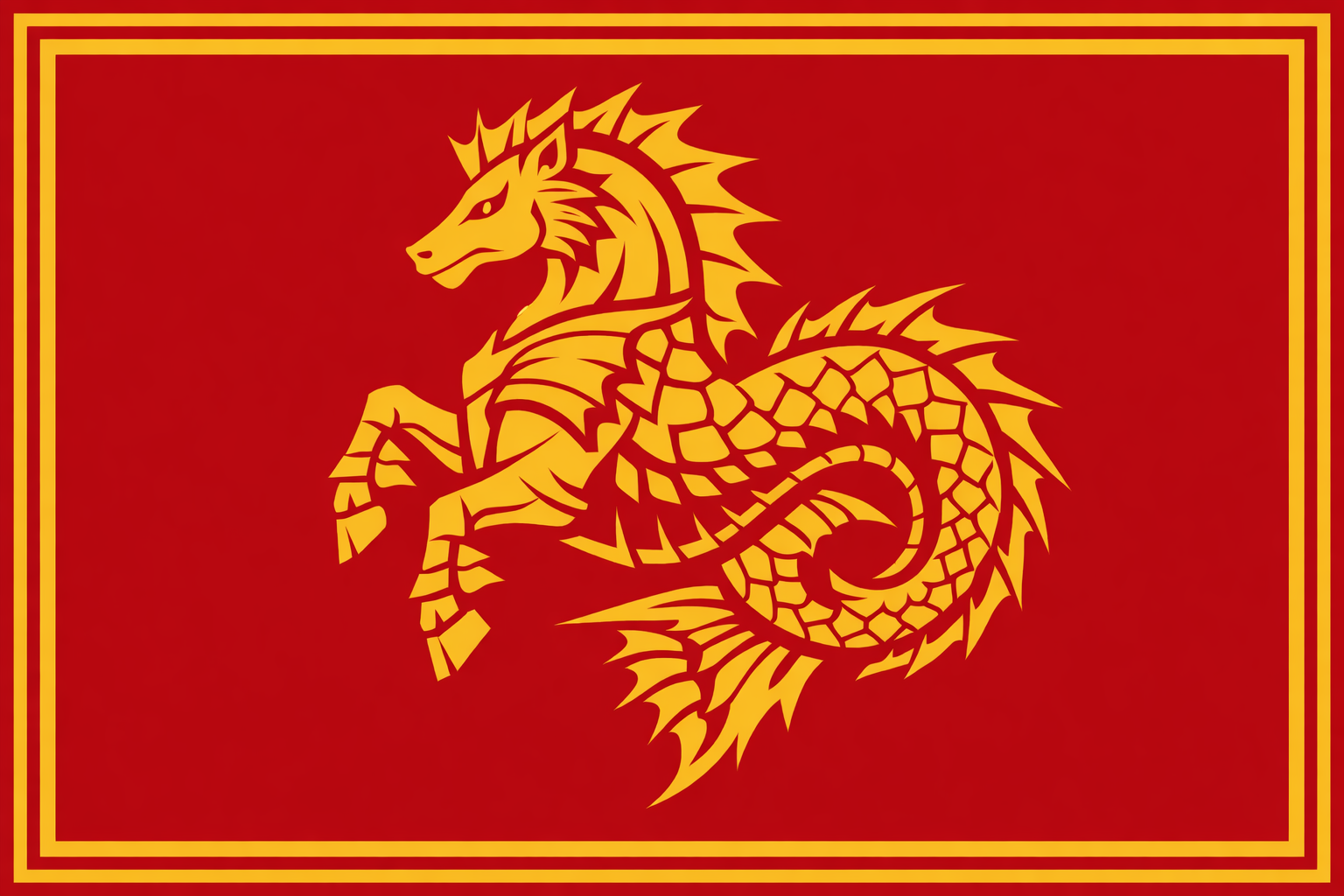
The Empire's heraldic banner displays a golden sea-horse on a scarlet field, bordered in gold. The sea-horse — rendered in the angular, predatory style of formal heraldry, with a crested mane, armoured fins, and a barbed coiled tail — faces the hoist side, statant and alert. The scarlet and gold combination signals both martial authority and maritime wealth.
The choice of symbol was personal. Galenus, who had come from somewhere cold and distant and would never return to it, fell in love with the Nostrum on sight. He is recorded as saying, sometime in the early years of his reign:
"This is the most blessed land and sea I ever saw in years of wandering. Its only bane is the strife of its people. I will end it, and make here a realm to prosper."
He chose the sea-horse to honour those warm southern waters. Every successor has kept it, and the banner has not changed in five hundred years. Its appearance in a foreign port tends to produce a range of reactions depending on the port.
"Everyone needs to eat. We decide who eats well."
— Empress Maren De Valoren
The Midland Empire is not the most magically powerful civilisation in the known world — that distinction belongs to the Highfolk. It is not the most technically or industrially advanced — that belongs to the Deepfolk. What it is, and what no other power has managed to replicate, is indispensable. The Empire feeds the world. And the world, whatever else it may think of the Empire, has never found a way to stop needing to be fed.
The Inner Sea's coastlands and river valleys constitute the most productive agricultural territory accessible to any of the three races. The Empire works them with a large, experienced population, roads capable of moving produce over long distances, and Conclave mages assigned to weather management and crop protection — ensuring that harvests mature, that unseasonal storms are mitigated where possible, and that the food supply remains reliable from year to year. The result is an output that neither Highfolk floating gardens nor Deepfolk underground cultivation can approach.
Highfolk cities can sustain themselves on sky-hunting, floating gardens, and magical sustenance in a technical sense. They do so miserably and inefficiently. The Deepfolk tunnel-farms produce root crops and fungi adequate for survival and little beyond. Both races are aware of this. The Empire's leverage, accordingly, is considerable — and entirely deliberate.
As Jovan, the Empire's chief merchant representative in Aeloria, once put it with characteristic brevity: "Wings or not, every person has a stomach, and stomachs need food three times a day. Ain't much to get a bite up here."
The Empire's position as the essential intermediary between Highfolk and Deepfolk is both geographical and political. The two races despise each other with a consistency that centuries of coexistence have done nothing to erode. They do not trade directly if they can avoid it. The Empire ensures they cannot avoid it — not through force, but by making itself the only efficient route through which goods move between the sky and the deep.
The exchange runs in both directions. The Empire exports food, timber, and surface goods downward to the Deepfolk and upward to the Highfolk. In return it receives ore, refined metals, gemstones, and Deepfolk mechanical technology from below; magical items, enchantments, storm crystals, and cloud-silk from above. Deepfolk ore reaches Highfolk forges via Imperial warehouses. Highfolk storm crystals — power sources for Deepfolk machinery — travel the same route in reverse. The Empire takes a cut on every transaction. It has done so for five hundred years.
"The Empire runs on trade. No trade — no Empire." Maren's assessment, from a private dispatch, is accurate enough that it has never required revision.
Among Empress Maren's domestic achievements, the Queen's Highway stands as the most visible. A paved road running the full north-to-south length of the Empire — from the edge of the Hill Country down through every major provincial capital to Maritana itself — it transformed the movement of goods, troops, and people across the interior in ways that are still accumulating. Before it, produce from northern provinces reached the coast slowly, expensively, and unreliably. After it, the journey times halved and the spoilage rates fell sharply.
An east-to-west equivalent was never built and is not planned. The Inner Sea renders it unnecessary — coastal shipping is faster and cheaper than any road for lateral movement across the Empire's width, and the Nostrum's trade routes have served that function for centuries.
The Empire's economic position is powerful and, under competent management, self-reinforcing. It is not, however, without vulnerabilities.
A war between Highfolk and Deepfolk — the scenario Maren works to prevent above all others — would collapse the trade triangle immediately. Both races would cease to need an intermediary the moment they were actively trying to destroy each other, and the Empire, positioned literally between them, would become a battlefield rather than a broker. The consequences — trade collapse, political fragmentation, refugee crisis, famine — are understood in detail by everyone in the Imperial administration who thinks about the long term. Most of them try not to think about it too often.
The Empire also faces a structural dependency it prefers not to acknowledge in formal documents: its agricultural dominance depends on stability, Conclave weather management, and functioning roads. All three can be disrupted. The Wild Baronies, Gorthan princedoms, and ordinary piracy on the Nostrum create friction at the margins. A sufficiently severe disruption at the centre — a coup, a civil war, a catastrophic failure of Imperial authority — would ripple outward through every trading relationship the Empire sustains.
The Imperial Creed is the Empire's state religion, privileged above all others by the Founding Laws and woven into the constitutional structure of Imperial rule. Its supreme deity is the Divine Sovereign; the Emperor or Empress is the Hand of the Sovereign on earth. The Creed is administered by the Warden Council — colloquially the Bishop council — headed by the High Warden, commonly called the High Bishop. Its intelligence corps, the Order of Confessors, operates throughout the Empire and beyond.
The Founding Laws guarantee broad religious freedom across Imperial territory, subject to three conditions: respect for the Creed's primacy, theological support for Imperial authority, and the prohibition of atrocities. The Creed's own summary of its position toward the general population: Practice optional, respect required.
The Empire sustains dozens of other faiths — the War Cult of the Rulen, Tuon's ancestral traditions, informal sea-spirit veneration among sailors, and many more. The Wild Baron Lands host faiths banned within Imperial borders, which the Creed treats as its primary argument for why the Three Rules exist.
For the Creed's full history, theology, hierarchy, the Sovereign Relics, the Order of Confessors, and the Empire's broader religious landscape, see The Imperial Creed.
Mind Magic is the only form of magic permitted within Imperial borders, and the Conclave is the only institution permitted to practice it. This arrangement is established by the Codex of Arcani — laws written by Galenus at the Empire's founding — and rests on three principles: Fidelity to the throne, Autonomy from all other Imperial authority, and Monopoly over magical practice, including the right to hunt down unlicensed practitioners. Any person born with magical ability must either join the Conclave as an Apprentice or refrain from using it permanently.
Forbidden arts — Necromancy, Blood Magic, Witchcraft — are hunted actively. Judicial authority over all magical matters, including illegal practitioners, belongs exclusively to the Conclave under the Codex's principle that only a mage can judge a mage.
The most significant legal anomaly is the Wind-Callers of the Rulen, whose shamanistic practice was reclassified as religion rather than magic under political pressure, allowing them to continue operating in Rulen territories. The Conclave accepted this argument. Their private opinion of it has never been formally recorded.
For the Conclave's full history, hierarchy, culture, and its relationship with the Creed, see The Conclave.
The Imperial military is, like the Empire itself, a paradoxical combination of hard discipline and chaotic diversity. When fully assembled and properly motivated — as Empress Maren demonstrated during the barbarian wars of her early reign — it constitutes a force that nothing in the human world can match. Getting it fully assembled and properly motivated is the work of years, iron will, and considerable political skill. The Empress herself has described it, in a private dispatch that was never intended for wider circulation, as a very mixed bag held by an iron hand.
The twelve provincial baronies each maintain standing armies organised to Imperial standards, officered by generals trained in Maritana. The barons nominally command their own forces. In practice, where a baron is competent and present, he leads. Where a baron is neither — and the Imperial records contain several who were neither — Maren's generals exercise effective command while the baron's banner continues to fly above the camp. The appearance of baronial authority is maintained. The reality is managed from the capital.
The three allied kingdoms field their own armies, organised broadly along Imperial lines but retaining national character, command structures, and a persistent tendency to follow their own strategic judgements when Imperial orders are inconvenient.
The Rulen contribute cavalry of a quality unmatched anywhere in the human world. Fast, ferocious, and operating under the complete authority of their own War Cult commanders, they are most effective when given an objective and left to pursue it in their own fashion. Attempts to integrate them into standard Imperial formations have produced mixed results.
The Battlemage Corps of the Conclave functions as the army's artillery — devastating, precise, and deeply reluctant to accept orders from anyone they consider a profane. They will obey the Empress directly, addressing her as the Wisest in accordance with Conclave custom. They will cooperate with provincial generals when it suits them. They will do as they please when it does not, and no amount of formal military hierarchy has yet produced a reliable alternative. They are also, when deployed effectively, the single most lethal element on any battlefield they enter.
The Order of Confessors, the Creed's intelligence corps, does not consider itself a military institution and will say so firmly if asked. It is, nonetheless, among the most strategically valuable assets available to the throne. Modelled on the learned orders of the Creed, Confessors are trained extensively in languages, regional customs, and the arts of persuasion and negotiation. They operate throughout the Empire and beyond it, gathering intelligence, cultivating influence, and managing the slow accumulation of information that allows Maren to know things she should not be able to know. They involve themselves in direct military action only when the threat is severe enough to justify it — defined, in Confessor doctrine, as severe danger to the Empire itself or to the Empress personally. The distinction between those two categories has occasionally been a subject of theological debate within the Order.
The Sovereign Relics, held by the Bishop council in the cathedral vault, represent a final reserve that the Creed deploys only when the Empire faces existential threat. They have been used fewer than a dozen times in five hundred years.
The Empire's dominance of the Inner Sea is real and has been maintained for generations. It is also maintained through three distinct naval factions that share a body of water and a nominal allegiance to the throne while harbouring varying degrees of mutual contempt.
The Imperial Fleet, based in Maritana, is the largest organised naval force on the Nostrum — well-funded, well-manned, and operating under formal military command. It is not, however, the fastest or the most technically sophisticated force on the sea.
That distinction belongs to the Ospreys — the autonomous flotilla of the Trade Republic of Lunara, crewed by hired professionals paid well enough to be genuinely motivated, commanded by admirals recruited for excellence rather than birth, and maintained to a standard of technical seamanship that the Imperial Fleet has never quite matched. Lunara's interest is commercial security rather than territorial control, which means the Ospreys fight to protect trade routes. They are exceptionally good at it. In direct engagements they have demonstrated, on several memorable occasions, that size is not the same as capability.
The Queen's Corsairs predate Maren's reign but were transformed by it — given formal letters of marque, Imperial funding, and access to trained instructors in exchange for operating under nominal Imperial authority against piracy and hostile shipping. They are, by temperament and tradition, pirates who have been persuaded that working for the crown is more profitable than working against it. The persuasion holds, mostly. They despise the Ospreys, who have beaten them more than once, and give the Imperial Fleet a wide berth. They are most useful in grey zones where formal Imperial presence is politically inconvenient.
The Conclave maintains several vessels of its own — magically propelled, armed with arcane artillery of considerable destructive power, and answerable to no authority except the Conclave itself. They operate on the Nostrum when mage business requires it. They do not coordinate with the other naval factions unless they choose to.
Under previous rulers, these factions came to open conflict more than once. Under Maren, they do not. This is less a product of institutional harmony than of the Empress's personal authority and the collective understanding that she is paying close attention. It is a fragile consensus rather than a solid partnership.
The result, across the Nostrum, is a patchwork of overlapping jurisdictions, grey zones where two or more factions' influence collide without resolution, and blind spots where none of them is reliably present. Gorthan princedoms, Wild Baron merchants and smugglers, and ordinary rogues move through these gaps — not freely, but persistently.
Imperial ships rarely pass through the Outer Straits into the open ocean beyond. The weather there is severe and unpredictable. In certain regions, magical navigation fails without explanation — the Conclave's working theory involves sunken ruins of some immense ancient power, though this remains unverified. Ships of unknown origin and hostile intent have been encountered. Several expeditions dispatched by ambitious emperors to explore the outer ocean have not returned.
The practical reasoning against further attempts is straightforward: the Empire has sufficient complications within the Nostrum, and above and below it, to occupy its resources indefinitely. Sending fleets into waters that have swallowed every previous fleet sent there requires a justification that ambition alone has not yet provided.
"I have spent thirty years travelling the known world and writing about what I found. I have lived in Highfolk cities where your worth is measured in wing-count at birth and does not change thereafter. I have passed through the Expanse, where peace is a pause between raids. I have visited the Wild Baronies, where the road outside any town is an adventure nobody asked for. I have read what little reaches the surface about the Deepfolk and their nine clans — admirable in some ways, impenetrable in others, and entirely uninterested in explaining themselves.
The Midland Empire has corrupt barons and a ruthless empress and an institutional church that supports whoever is paying its cathedral repairs. It has mages who consider everyone beneath them and corsairs who rob ships under Imperial colours and roads that are excellent in the north and non-existent in the east. I have complaints.
It also has no inborn hierarchy of blood and bone that decides your fate at birth. It has class barriers that are high but not walls. It has official religion that most people observe casually and ignore privately without consequence. It has poverty in the cities and hard seasons in the provinces, but it has not had famine in living memory. It has, in short, all the ordinary failings of human governance and none of the extraordinary ones.
For those who do not fit — the restless, the strange, the unlucky — there are the Corsairs, the merchant roads, the provincial cities where nobody knows your name. The Empire is large enough to get lost in. That is, in my experience, undervalued as a quality in a state.
I have been asked many times which realm I would choose to live in, if I could choose freely. I always answer the same way: the Empire, without hesitation, and with full awareness of its faults. The Sovereign knows how the Deepfolk clans actually work — they are not telling — and perhaps that system is better. Everything visible from the outside suggests it might be. But I cannot live inside something I cannot see.
The Empire I can see. It is, as political arrangements go, the least bad option currently available. I have looked.
One thing more, which I did not appreciate until I had been elsewhere long enough to notice its absence: the Empire does not teach that other peoples are lesser. Individual Imperial citizens can be fearful, ignorant, or rude toward non-humans — I have witnessed all three. But no Imperial institution, no official doctrine, no body of law declares the Highfolk or the Deepfolk to be inferior or intrinsically wrong in their nature. The Conclave, for all its contempt toward unmagical humans, has nothing but technical respect for Highfolk enchantments and Deepfolk mechanisms — getting one's hands on an otherfolk artefact is, I am told, the private ambition of almost every mage in Arcani. The Imperial Creed, meanwhile, holds a theology that names non-humans the Other Children of the Sovereign — different, not damned. It would gladly preach to them if they would listen. They will not. The Confessors have been attempting missions to Highfolk cities and Deepfolk settlements for centuries and have achieved, so far, a record of polite refusals and occasional violence. They continue attempting. The Empress supports the effort, I suspect less from faith than from the calculation that a single converted sky city would be worth more politically than a decade of trade negotiations. She is probably right. It has not happened yet.
Compare this to the theology of the First To Fly — the eight-winged god of the Highfolk — whose faith treats wingless creatures as beings without souls worth considering, and the contrast is not small.
I said the Empire is the least bad option. I should add: it is also, in this respect, better than the available alternatives in a way that is not merely relative. That is rarer than it sounds.
My one significant reservation — and I leave it for last because I do not know what to do with it — is the question of succession. The Empress has no heir. She is not young. The Founding Laws are clear on what happens when a De Valoren widow dies without having secured the line: any man who can prove the blood may claim. There are, at present, no obvious candidates. There are also, at present, no obvious candidates who are not being watched very carefully by people who report to Maritana. What happens when there is no one left to watch, or no one left watching — I confess I do not know. Neither, I suspect, does she.
— Aldric of the Barren Lands, Observations on the Known World, compiled in the forty-third year of Empress Maren's reign (attributed; authorship disputed by the Warden Council, which has declined to specify its objections)
This article is about a Location & Political Entity — Human Empire
| World Overview | World Index |
| Cities | Maritana · Lunara |
| Peoples | Human · The Three Races |
| Factions | The Conclave · Queen's Corsairs · Wild Baron Lands |
| Culture | Imperial Creed · Languages |