✅ This article contains no spoilers. It's all background lore on the winged race — read on.
The Highfolk are the winged race of the sky realm — humanoid, powerful, and convinced of their own superiority with a thoroughness that can only be sustained by a civilisation that has never seriously had to defend the claim. They inhabit a network of floating cities hovering at altitude above the surface world, govern themselves through competing city-states each with its own government and character, and have spent the better part of eight centuries constructing a social order that places wing-count at the centre of every question of worth, power, and divine favour.
They call themselves the Highfolk. Deepfolk call them Khrosh — "lankies," in a Deepfolk word that carries considerable contempt. Humans, in contexts where Highfolk cannot hear, tend toward blunter terms.
Highfolk are taller than humans — significantly so, built along lines that suggest a different relationship with gravity. Their bodies are lean and muscular in ways specific to flight: powerful across the shoulders and upper back where flight muscles attach, lighter-framed than their strength implies, with hollow bones that add lightness without sacrificing structural integrity. Their skin runs pale, tending toward white or ivory, with colouring that does not vary as widely as among humans.
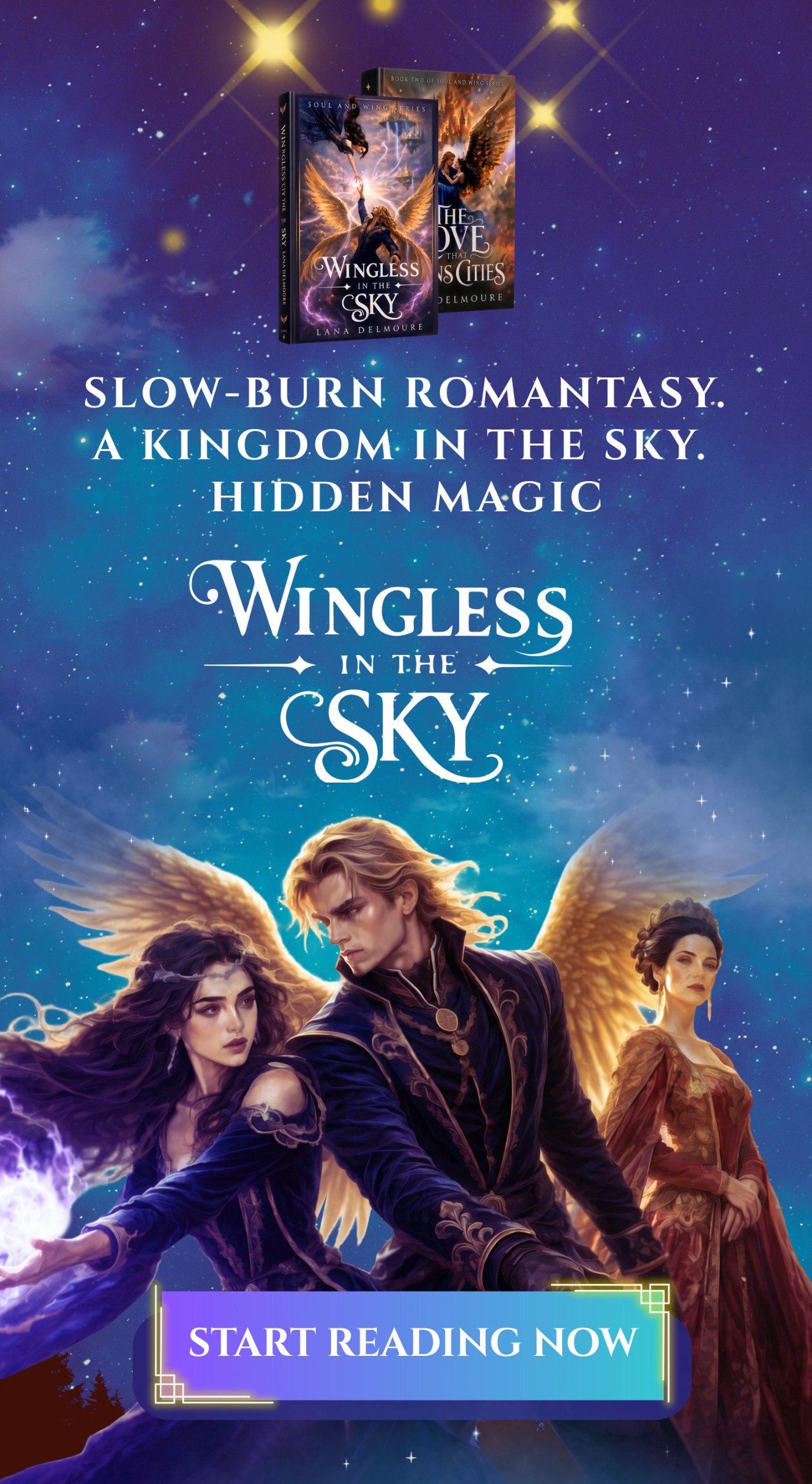
The defining feature is, of course, the wings — two or four, depending on birth, attached to the back and fully functional as organs of flight. Wings are not merely physical structures. They are partly magical, serving as conduits for heart magic, and a Highfolk's magical capacity is directly tied to their wing structure. Larger wings, more wings, healthier wings — more power.
Celestials — known formally as the Twice-Born or Four-Winged — make up roughly five to ten percent of the Highfolk population. They are born with four wings where others have two, and the difference is not merely aesthetic. Four wings provide significantly greater magical capacity and control. A Celestial heart mage can accomplish feats that a two-winged practitioner of equal training and talent cannot. This is not contested, even by those who oppose the conclusions drawn from it.
Celestial wing colours are restricted to pure gold, silver, and white — the shades associated with divine favour under traditional theology. Any deviation from these colours in a Celestial bloodline — brown or grey edging, mixed colouring — is called the taint, a sign of genetic dilution from interbreeding with two-winged lines, and treated as a source of profound shame. Families in which tainted colouring appears go to considerable lengths to conceal it.
Two-winged Highfolk — the majority, making up the bulk of the population — are the ordinary Highfolk, which is to say the ones who do most of the work. Their wings run the full spectrum: brown, grey, and black are most common, with other colours appearing. In the caste system of traditional cities, no wing colour among the two-winged carries prestige. They are simply the colours of people who were born with two wings.
Highfolk live roughly a third to forty percent longer than humans — where a human life runs sixty to eighty years, a Highfolk in good health can expect a century or more. This is long enough to accumulate significant power and knowledge but not so long as to produce the extreme generational gaps that characterise Deepfolk society. An aged Highfolk is formidable. They do not become geological.
Two Celestials together usually produce a Celestial child. A Celestial and a two-wing producing a child is, in practice, nearly unheard of — the social barriers are severe enough that it almost never occurs, and when it does the story tends to become the kind of scandalous, half-whispered tale that circulates in Highfolk society for generations. The child of such a union is virtually always two-winged, the Celestial trait diluting immediately. Two two-wings do not produce Celestial children. The four-wing trait does not spontaneously reappear once diluted out of a line.
Inter-race breeding between Highfolk and other races is essentially unheard of, forbidden by law in most cities, and treated as sacrilege by the dominant religious tradition. Whether it is biologically possible has never been formally investigated in any Highfolk context, because investigating would imply the question deserves consideration.
The hierarchy of Highfolk society rests on four interlocking pillars, each reinforcing the others:
Magical superiority is the most straightforwardly defensible — Celestials are, on average, objectively more magically powerful. Four wings provide greater conduit capacity. The magic is real. Trossan scholars argue, with some force, that this is a self-fulfilling outcome: Celestials receive exclusive magical education, exclusive access to advanced texts, exclusive training environments, and then are pointed to as proof of inherent superiority. This argument has yet to change the minds of anyone who benefits from the current arrangement.
Educational monopoly maintains the gap: Celestials receive comprehensive schooling in governance, history, strategy, and high magic. Two-wings are educated in practical trades and limited accordingly. The system is designed so that the intellectual credentials Celestials cite as proof of their fitness to rule are credentials only Celestials are permitted to acquire.
Religious foundation is the deepest root. Under traditional Highfolk theology, four wings are a divine blessing — physical evidence of closeness to the First to Fly, the eight-winged creator. The caste system is not constructed; it is ordained. This makes challenging it not merely political opposition but heresy, with all the social and legal weight that implies.
Institutional entrenchment is what keeps the system standing even when individuals within it have doubts. Eight centuries of tradition are woven into every aspect of Highfolk life — architecture, law, economy, ritual, marriage custom, language. Dismantling it would require dismantling everything built on top of it. Even pragmatists who do not believe in divine Celestial mandate can look at the scale of the disruption and decide the status quo is preferable to the chaos of change.
The caste distinction pervades daily life. In traditional cities, Celestials occupy the upper districts — literally higher in the floating city's structure, closer to the sky. Two-wings live below. Separate temples, separate market sections, separate public baths. Where shared spaces exist, they are divided by protocol: two-wings bow and avert eyes, wait until Celestials have eaten, wear clothing in colours not reserved for the upper caste.
Legal asymmetry formalises the hierarchy: a Celestial who injures a two-wing faces a minor penalty; a two-wing who injures a Celestial faces severe punishment or death. Celestials accused of crimes are judged by other Celestials. The law reflects the social order, as law tends to do.
Marriage across caste lines means permanent loss of Celestial status — not just for the individual, but effectively for their line, since children inherit the lower parent's wing-count. A two-winged child born to Celestial parents is a source of shame severe enough that such children are sometimes hidden, fostered out, or quietly abandoned.
The caste system is not politically uniform. Three major factions represent genuinely different positions on how the system should function — or whether it should:
The Purists hold that Celestial supremacy is divine mandate and that the current era represents dangerous erosion of a sacred order. They want stricter segregation, tighter enforcement of caste distinctions, and in more extreme expressions, are not troubled by the idea of purges. Their power base is the most traditional cities — Zelos above all — and the religious establishment. They view pragmatist Celestials as weak collaborators and Trossan ideology as an existential threat.
The Pragmatists, sometimes called Moderates, accept Celestial superiority as real but argue that rigid supremacism is strategically foolish. Cooperation with two-wings produces better outcomes — economically, militarily, diplomatically. They maintain the hierarchy but govern it with a lighter hand, permit two-wings to fill significant roles below the reserved ones, and trade with wingless races rather than treating contact as contamination. Aeloria is their natural home. They find Purists dangerously fanatical and Trossans dangerously radical.
The Trossan Radicals — followers of the ideology developed in and around the city of Tross — reject the theological basis of Celestial supremacy entirely. Their claim is that wing-count has nothing to do with divine worth, that the First to Fly valued flight as metaphor — courage, freedom, aspiration — and that the current wing-count doctrine was inserted into theology roughly eight centuries ago by Celestials who wanted religious cover for a power grab they had already made. They possess, or claim to possess, older scriptures that support this reading. They want abolition of Celestial privilege and full equality for all Highfolk. In their more expansive formulations, they extend this to all races.
Highfolk civilisation is organised into independent city-states — each a floating city with its own government, military, and cultural character, sharing a common language and religion while competing politically and sometimes militarily. One people, many cities, united mainly against outsiders.
The wealthiest and most cosmopolitan Highfolk city, seat of King Solarian and the royal line, home to the Moderates and the pragmatist tradition. Trade with the surface world is extensive; a human quarter exists within the city, tolerated and commercially useful. Aeloria was recently at war with Zelos — a war that ended in stalemate and a secret truce — and its Core is damaged, a fact known only to the ruling class and key scholars. See Aeloria.
The militant city, Purist stronghold. Governed by a council of high priests and military commanders, possibly exclusively Celestial in population, deeply suspicious of all compromise with the two-wings or the wingless races. They make raids on weaker surface nations for resources while hypocritically purchasing food through Aeloria — contact with the wingless that ideology forbids and economics requires. They were at war with Aeloria until the secret truce, and they remain the primary military threat to any egalitarian project. The adjective is Zelan. See Zelos.
The revolutionary city. Tross has rejected Celestial supremacy in law and practice: Celestials and two-wings hold equal status, the government is an elected council with mixed representation, and the city is the only one in the sky realm openly welcoming to wingless visitors. It is allied with Deepfolk clans (technology exchange) and Midfolk (trade and diplomacy), and fields the largest air fleet of any single city by virtue of an integrated military that draws on two-wings as full combatants. Traditional Highfolk cities regard it as heretical, destabilising, and potentially infectious. They are not wrong about the last part. The adjective is Trossan. See Tross.
A mid-sized city and longstanding trade partner of Aeloria, oriented toward commerce rather than military power or ideological purity. Moderate in politics, prosperous, less prominent in the current conflicts than its size might suggest. Its caution keeps it out of the worst confrontations and limits its influence in equal measure.
A city that no longer exists. One hundred and fifty years ago, the Core of Amaeron failed. The city fell. The official Highfolk account holds that enemy sabotage was responsible — a convenient explanation that avoids the more disturbing truth: the Core simply failed, as Cores will, without anyone's help, and no one knew how to stop it. The wreckage lies at the bottom of the Inner Sea. Every Highfolk who knows the real story lives with the awareness that the same fate awaits any city whose Core degrades far enough, and that no one currently knows how to prevent it.
Five further cities make up the broader sky-realm civilisation. Thessara specialises in scholarship and astronomical study. Pammyra is isolationist and deliberately mysterious. Alcyria is hedonistic and politically neutral, having decided that decadence and non-alignment are equally comfortable positions. Sapphyros is a Purist religious centre and spiritual ally of Zelos. Korinna and Boerios are secondary military cities, neither as extreme as Zelos nor as commercially minded as Aeloria.
Every floating Highfolk city is kept aloft by a Core — an enormous crystalline mechanism of ancient origin, housed at the city's heart. The inner sphere, approximately fifty feet across, contains what appears to be white lightning trapped in crystalline suspension. Around it sits an outer energy barrier, roughly eighty feet in diameter, that prevents access to the inner sphere. The Cores emit the magical field that keeps the city suspended at altitude and provides the primary power for magical infrastructure throughout the city.
They were made by the First Builders — a term that refers to the mythical founding generation of Highfolk civilisation. According to tradition, the First Builders did not discover Core construction through their own art: they were taught it directly by the First to Fly, who gave them the knowledge as a gift at the beginning of the world. The Cores are therefore not merely engineering but theology made physical — the god's own gift, sustaining his people's cities. What is also known is that Core creation is an art entirely lost. No Highfolk currently alive knows how to build one, and — critically — no one knows how to repair one either.
The outer barrier is impenetrable by any technique currently understood. Highfolk heart mages perform a ritual they call wing-sharing — Celestials standing in a circle around the Core, crossing wings, channelling power together — in repeated attempts to open the barrier and reach the inner sphere. It fails every time. No one has successfully explained why.
The consequence is that every damaged Core is a ticking problem. Amaeron proved what happens when one fails entirely. Aeloria's Core sustained damage during the recent war with Zelos — a crack that has been slowly growing, kept secret from the general population, dreaded by everyone who knows about it.
Origin, and the ancient texts it preserves, suggest that the First Builders received their knowledge under conditions that have since been lost — and that the "wing-sharing" ritual required to repair a Core has been misunderstood for centuries. This is the interpretation that the dominant theological tradition has suppressed for eight centuries.
The dominant Highfolk religion centres on the First to Fly — known also as the Twice-Twice-Born, Ourannos Pteryx, and the Eight-Winged God. According to traditional theology, the First to Fly created the world from clouds and storms and made the Highfolk in his image. Most Highfolk are born with two wings; Celestials, with four, are closer to the divine ideal; and the prophecy holds that one day an Eight-Winged will be born and lead the Highfolk to transcendence.
The theology supports the caste system at its root: wing-count is divine information. The more wings, the more favoured. Interbreeding with the wingless corrupts divine bloodlines and is treated as near-sacrilegious.
The theological movement known as Origin — called the Trossan heresy by its opponents, though it predates Tross as a political force — claims to preserve the original faith, before Celestial interpretation reshaped it. In the Origin reading, the First to Fly never cared about feathers. Eight wings represent the Eight Virtues — Courage, Wisdom, Justice, Mercy, Strength, Honour, Freedom, Unity — and any Highfolk who embodies them flies closer to the divine than a Celestial who embodies none. The wing-count doctrine, Origin scholars argue, was inserted into theology approximately eight hundred years ago by Celestials who wanted religious legitimacy for a social hierarchy they had already constructed.
Origin preserves ancient texts — pre-Classical in language, authenticated by scholars who have examined them — that support this reading. Their existence is deeply inconvenient for the traditional establishment. The sect is suppressed and considered heretical in most Highfolk cities. In Tross it is the state theology, which is a significant part of why other cities regard Tross as dangerous.
All Highfolk cities share a common tongue — the Koine, meaning simply "common speech." It developed from older regional dialects that have largely disappeared, leaving Koine as the only surviving branch. To human ears it sounds archaic and somewhat cryptic: abundant in hard consonants (k, th), unfamiliar vowel combinations, and a music that does not map to human linguistic expectations.
Highfolk of the educated class tend to speak Middlish well when they choose to, and some disdain to demonstrate it.
Speech style varies by caste and city. Celestials speak formally and at length, with complex vocabulary and a preference for metaphor. Thou and thee are reserved for ceremonial occasions, extreme emotion, ancient oaths, and — pointedly — condescending dismissal. The very highest ranks use third-person self-reference. Two-wings speak directly and concretely. Trossans are educated but plain-spoken, using "we" more readily than "I" — collective identity expressed through grammar.
Highfolk naming follows distinct patterns by sex and caste.
Male names end in -os, -on, -as, -an, or -or: Kyrian, Zephyros, Theron, Solarian, Kallios.
Female two-wing names end in -is or -es: Thalis, Lyris, Daphnes, Koris.
Female Celestial names use double-vowel endings — -aeis, -eas, -aea, -eia, -oia: Aethraeis, Lyraea, Cassaeas, Kalleia. The phonetic complexity is a social signal audible in the name itself. Hearing a name tells you the speaker's caste before anything else.
Highfolk technology is entirely magical in basis — there is no mundane mechanical tradition. Airships run on magical propulsion. City infrastructure is powered by Core-derived magic. Personal transport is either flight or magically propelled craft. What they cannot accomplish with magic they tend not to accomplish at all, which makes them simultaneously spectacular and strangely limited in areas where magic is not the answer.
Aesthetically, traditional cities — Aeloria and Zelos foremost — are gorgeous in the way that civilisations become gorgeous when they have had a long time and a great deal of wealth to work on the problem. Gold, silver, carved marble, silk; architecture that makes beauty a performance and treats performance as proof of worth. The cities gleam. This is deliberate.
Tross is the deliberate opposite: plain, functional, whitewashed stone. The resources that other cities spend on spectacle, Tross spends on its people. Traditional Highfolk find it depressing. Trossans find traditional cities exhausting and slightly dishonest.
The Highfolk position toward other races is, in traditional cities, one of reflexive superiority. Wingless races — humans and Deepfolk alike — are inferior by definition; the divine order expressed in wing-count makes this a theological statement, not merely a social attitude. Trade with the wingless is tolerated as a necessary evil, and the presence of human traders in cities like Aeloria is permitted because the food supply requires it. This does not translate into respect.
Deepfolk they call Grubmen — worms in dirt — which is the one insult that reliably produces a violent reaction from Deepfolk on the receiving end. The mutual contempt between the two races is among the more stable dynamics in the known world.
Tross is the exception to all of this, which is exactly why the other cities regard it as dangerous.
This article is about a People — The Winged Race
| World Overview | World Index |
| The Three Races | The Three Races · Deepfolk · Human / Empire |
| Sky Cities | Aeloria · Tross · Zelos |
| Magic | Heart Magic · Hand Magic |
| Religion | The First to Fly |