⚠️ This article contains mild spoilers for Wingless in the Sky (Book 1).
"My beautiful prison."
— Lia Domiandi, on first sight of the city
The city is ruled by the royal House Solanthis under a system known as the Sky Court — a monarchy tempered by assembly, where the great Celestial families argue and deliberate, and the king decides. It is home to approximately forty thousand Highfolk and a small community of perhaps two hundred wingless residents: merchants, craftspeople, and the occasional political anomaly that the city finds it cannot afford to turn away. For those two hundred, Aeloria is a place of opportunity and indignity in equal measure. For everyone else, it is simply home — beautiful, contentious, endlessly complicated.
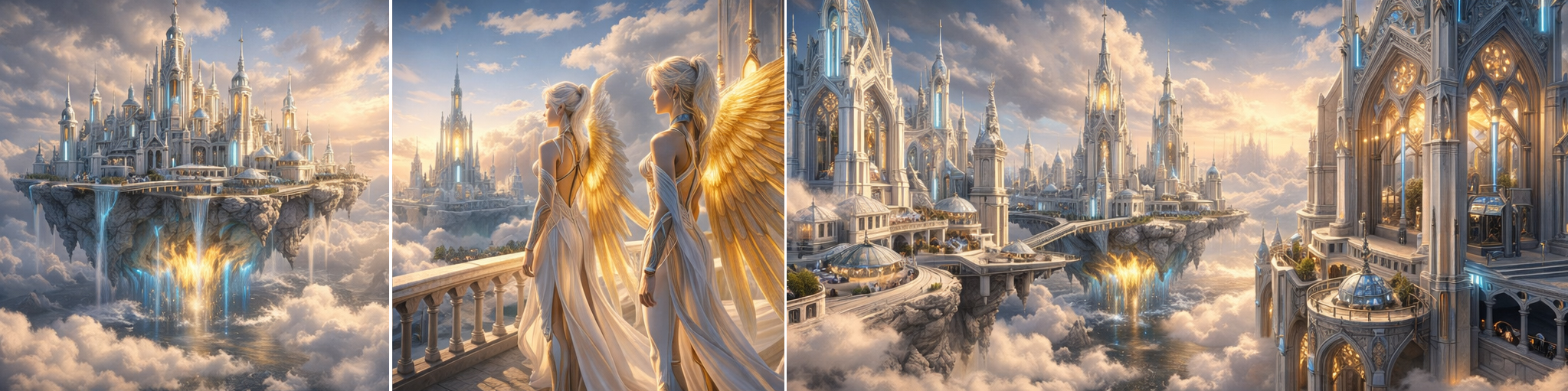
Approaching Aeloria from below, the first impression is one of impossible light. White stone catches the morning sun and throws it back in brilliant flashes. Gold and silver accents catch it too, and columns rise from the city's platforms toward the sky like the architecture is trying to finish what flight started. Temples with triangular pediments line the higher districts, their marble sides carved with winged figures — Highfolk holding spears, holding scrolls, raising hands in benediction toward the open air. Statues stand everywhere. The city has been building monuments to itself for a very long time.
The structure beneath all this beauty is, by earthly standards, impractical to the point of strangeness. Aeloria was designed by and for people who fly. Buildings rise on thin pillars. Bridges connect them, but the bridges are barely wide enough for two people to pass side by side, and the walking surfaces between them are limited to narrow walkways. Structures seem to float independently of each other, clouds drifting through the spaces between them, weaving in and out of the architecture. Hanging gardens cascade from balconies and ledges, vines trailing into open air with nothing beneath them. It looks like something risen from legend rather than built by hands.
For the wingless, this means navigating a city that was never built with them in mind. Service stairs and ramps exist, but as afterthoughts. Moon Whales — large, slow, domesticated sky creatures fitted with railed platforms — serve as the primary transit between districts for those who cannot fly between them themselves.
Two things disturb the beauty on closer approach. The outer districts lean very slightly, tilted as a painting hung just wrong. Water sits at an angle in a cup; loose things roll in unexpected directions. No one in the city mentions it, either because they have stopped noticing or because they prefer not to. And ringing the entire outer edge of the city, at even intervals from the lowest platforms, stand thin black pillars blazing with glyphs cut deep into the stone. Orange. Angry. Not decorative. Not architectural. A traveller with sensitivity to magic feels them before she can read them — a low, restrained hum, like something vast held on a very short leash. Defences of a kind that does not invite questions.
Aeloria is not formally divided, but its geography creates distinct zones that every resident navigates by instinct.
The highest ground of the city belongs to the royal house. The palace complex itself sprawls across its own elevated platform — white marble, terraced gardens, the Sky Court chamber with its dome painted like clouds. The royal gardens spiral up the sides of the great towers: flowers that should not survive at altitude, trees with silver bark and leaves that shimmer like hammered metal, fountains designed to sound like music. It is beautiful in a way that feels intentional rather than accidental. The palace quarter also contains the city's great temple, the spiritual and ceremonial heart of Aelorian public life.
The palace temple is the largest religious structure in Aeloria and one of the most significant in the Highfolk world. Its ceilings rise so high they are lost in shadow. Stained glass windows — depicting winged figures in flight, in battle, in prayer — cast coloured light across stone floors. The columns are carved to look like feathers. The entire structure is built on sacred geometry: eight columns, eight surrounding gardens, eight of everything, in honour of the eight wings of the First to Fly.
At the centre stands the statue. Thirty feet of white marble, carved with a precision that approaches the obsessive: the First to Fly himself, eight wings spread in perfect symmetry, one hand pointing toward the heavens, the other holding a sphere that might be the world. The face is beautiful and terrible at once. Eyes that seem to see everything. It is meant to make a person feel small, and it succeeds. The temples are formally open to all, but a wingless visitor will feel — and will be made to feel — that they are not quite what the space was built for.
Surrounding and adjacent to the palace district lies the Celestial quarter, where the four-winged aristocracy of Aeloria has its residences and its closest proximity to the Core. The buildings here are taller, more ornate, made of a crystalline material that seems to have grown from the city's magical foundations rather than been shaped by craftsmen. They pulse faintly with the same rhythm as the Core itself.
The quarter is sacred space in practice as well as name. Celestial residents have petitioned the palace over perceived intrusions — a wingless woman walking its streets is an affront to the local understanding of the divine order, regardless of whatever political dispensation permits her to be in the city at all.
At the quarter's most remarkable point floats the Emporios mansion — the only detached building in Aeloria, hovering on its own stone-and-crystal platform with no bridges connecting it to the surrounding streets and no visible supports beneath. Gardens cascade down its sides. Terraces wrap it like ribbons. Gold veins the marble of its floors; gold leaf covers its ceiling moldings; gold thread runs through its tapestries. A crystal bridge extends toward visitors only when they approach, responding to their presence. The mansion has its own Core, excavated from a smaller island at what must have been catastrophic expense, installed in the building's foundation so that it floats entirely independent of Aeloria's own magical infrastructure. It would remain aloft even if Aeloria's Core were to fail. People know this. People find it impressive and unsettling in equal measure.
At the geometric centre of the city, the Core dominates everything around it. It is a massive sphere — easily the size of a large palace — that pulses gold and white light with the regularity of a heartbeat. Looking at it directly is difficult; the light has a quality that sits just wrong behind the eyes. At any distance, the hum it produces is felt as much as heard. The surrounding buildings are the most crystalline in the city, as though the Core's presence has slowly altered the stone over centuries.
Those with magical sensitivity feel it differently. At a distance it is a pressure, a pull. Closer, it becomes nearly irresistible — a string attached somewhere behind the breastbone, drawing a person toward the city's heart whether they intend to move or not.
Aeloria's Core has been failing. The tilt of the outer districts is its most visible symptom — a slow, worsening deviation that the city's mages have not been able to arrest. The Core's collapse would mean the end of the city.
Multiple levels of docking platforms extend from the city's lower edge, connecting to the sky routes that feed Aeloria's commerce. Ships moor at different heights, connected to the city by ramps and walkways. It is a busy, organised place — Highfolk loading and unloading cargo, some simply flying from ship to shore rather than using the walkways at all. The first thing a new arrival sees, coming off a vessel, is the rows of faces turning to look.
Below the palace and Celestial districts, the human quarter occupies the spaces Highfolk do not want. Narrow alleys. Low-ceilinged buildings where wings would be uncomfortable. It is small and cramped, but it has its own warmth — markets, the smell of bread from Jovan's stall, children chasing each other between the vendor stands. For the two hundred wingless residents of Aeloria, it is the only part of the city that was built with them in mind, however accidentally.
Its far edge borders the Scar. The placement is not mentioned by anyone, but it is noticed.
The lowest and outermost districts are the poorest — architecture cruder, more functional, less ornamented. The tilt of the Core failure is most visible here. It is where the city stops pretending it is perfect.
A full district of Aeloria remains sealed, seven years after the war that made it. The Zelan forces struck this section with magical fire of a kind that does not burn like ordinary flame — it feeds on magic itself, burns hotter and longer, and cannot be extinguished by counter-spell or water. It ran for three days before exhausting itself. What it left behind is a landscape of blackened stone, melted and refrozen into grotesque shapes, collapsed buildings like broken skeletons, twisted metal. The air inside still tastes of ash and something metallic, like breathing in the memory of destruction. Floors crack underfoot. Walls lean at angles they should not survive.
The worst of the magical contamination — a kind of poison burned into the stone itself — took years to dispel and has not entirely been cleared. The Scar is still officially sealed. People have died in it. It is being rebuilt, but slowly: materials have to be shipped from the surface, construction at altitude is difficult, and the deep interior of the district remains dangerous. The edge of the sealed zone runs along the boundary of the human quarter. Most merchants won't touch property this close.
It is never said aloud that the burned district ended up adjacent to the place where the wingless live. It is noticed anyway.
The Sky Court is the governing assembly of Aeloria, convened in a circular chamber beneath a dome painted to resemble open sky. Benches descend in amphitheater fashion to a central tribune where speakers stand. The King's seat faces the tribune directly — whoever speaks addresses him first and the assembly second. It is not a coincidence of architecture.
Any prominent person of the city may speak. Celestials speak, argue, propose, oppose. Two-wings are present but occupy the furthest benches and do not raise their voices. The great factional divide is between the Moderates — trade-focused, pragmatic, willing to deal with the other races — and the Purists, who hold Celestial supremacy as both theological and political truth. House Solanthis, the royal family, holds the moderate position. House Emporios, the richest merchant family in Aeloria and the backbone of the Purist bloc, holds the opposition.
The court discusses. The king decides. It has always been a monarchy; the assembly exists to inform and advise and occasionally to constrain, but the final word belongs to House Solanthis. The Crown Prince presents analysis and argument; the king ratifies. When they are in agreement, the court moves efficiently. When they disagree, it is usually in private.
The most defining event in recent Aelorian memory is the war with Zelos, which ended seven years ago after five years of fighting. The official history attributes it to a trade dispute and territorial aggression. The actual history is simpler and less flattering: a public insult to King Solarian's honour during a state visit to Zelos, a declaration of war three days later, and thousands of deaths in consequence. Both sides fought hard and burned what they could reach. The Zelans struck the district now called the Scar with their worst weapons. Aeloria burned several Zelan vassal cities entirely — nothing left, not a wall standing.
By the fifth year, both sides noticed what the city of Tross had done with the time bought by their war: built a military, expanded alliances, grown into the most powerful force in the sky. The peace that followed was not a resolution. It was a calculation. Both cities decided, quietly and without admitting it, that their fear of Tross outweighed their hatred of each other. They signed papers. They shook hands. They still despise each other.
The insult was never answered for. The Scar was never answered for. Veterans of that war know what they fought for, and they live with it.
Since the war, the shadow that troubles Aeloria most is not Zelos but Tross — the city that rejected Celestial supremacy entirely and made it work. Tross is growing. Its integrated military is larger than Aeloria's and better supplied. Its theology, which Aelorian scholars dismiss as crude propaganda, is spreading through the single-wing populations of other cities. Aeloria watches it carefully, maintains its position of official opposition, and tries not to think too hard about why its Purist faction has been growing louder in direct proportion to how strong Tross has become.
The Core that keeps Aeloria aloft has been failing for years. The tilt of the outer districts is visible evidence. The mages have no solution. The first builders who created the Cores left no documentation, or none that survives. What repairs the Core requires, and whether it can be repaired at all, is the central unanswered question of Aelorian life — carried mostly in silence, because the alternative to silence is panic.
This article is about a Location — Sky City · Highfolk
| World Overview | World Index |
| Sky Cities | Tross · Zelos |
| Peoples | Highfolk · The Three Races |
| Key Characters | Kyrian · Solarian · Faedris · Beros |
| Religion | The First to Fly |