✅ No Book 1 spoilers — this is city lore. Contains minor setup for Book 2 (a character is introduced who joins the story later).
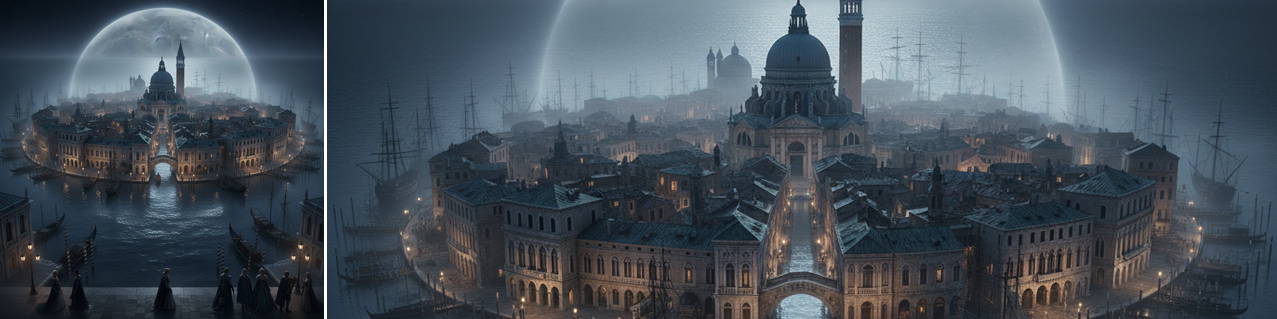
The island's circular shape gives the city its name. At night, when sea mist softens the lights of the harbour into a pale blur on dark water, the island is said to resemble a moon reflected on the surface of the sea. The Loonies see more of actual moonlight than most — the climate is humid and hazy, sea mist rolling in from all directions through much of the day, and the clearest skies come after dark when the night breeze pushes the haze aside. Locals joke that they know the stars better than the sun.
It is a Crown Domain — formally part of the Midland Empire, subject to Imperial law, with a Warden Council chapter in its main cathedral. In practice, it governs itself through institutions entirely its own, under terms negotiated at incorporation and never successfully renegotiated since. Maritana has tried. The Negotianum has always found ways to make the attempt more trouble than it is worth.
Lunara is an island city, which means water is everywhere and everything suffers for it. The architecture is opulent and perpetually damp — ochre, pale yellow, and pale green facades streaked with moisture, ornate merchant palaces whose ground floors flood in bad seasons, bridges and canal-walks connecting buildings that a drier climate would have connected with streets. It is beautiful in the way that expensive things are beautiful when they are also slightly ruined: the humidity has given everything a softness and a patina that newer cities lack.
If Maritana is white and grey stone with terracotta roofs — grand, formal, built to last and to impress — Lunara is colour and texture and the constant suggestion of mild decay underneath the splendour. The buildings lean toward each other over narrow waterways. Washing lines cross between windows six floors up. The great merchant palaces of the harbour front rise behind quays perpetually crowded with vessels from a dozen nations.
The harbour is the city's heart. The Negotianum building sits directly adjacent to the great market, not at the elevated political centre that a Maritanian planner would have chosen for the seat of government, but at the waterfront, among the commerce it exists to govern. The message is deliberate and accurate: in Lunara, money precedes politics.
"The town has more sails than houses. Half the time you can't see it behind the forest of masts."
— common Lunari saying
Maritana's skies belong to huge white gulls. Lunara's waterfronts are claimed by black cormorants — dozens of them on every dock post and harbour wall, watching the fishing boats with professional patience.
Lunara is governed by the Negotianum — a council of prominent merchants elected by the city's propertied population. The franchise is determined by property census: the more you own, the more influence your vote carries, and those below a minimum threshold of wealth do not vote at all. The Negotianum does not consider this a flaw in its design. It considers it a description of how consequential decisions should be made.
The council holds legislative and executive oversight, arbitrates commercial disputes, manages city defences, and negotiates trade agreements — including, on several documented occasions, agreements that technically required Imperial approval and received it only after the fact. Its chambers occupy the most prominent building on the harbour front, next to the great market, which is precisely where a Lunari council would choose to sit.
Executive power is held by a Doge, hired by the Negotianum for a fixed term. The Doge administers the city's day-to-day governance, commands the Ospreys in their naval capacity, and represents Lunara in formal dealings with Maritana and foreign powers. Street order in the city is kept by Osprey marines — the same force that crews the fleet, rotated through land duty — which gives Lunara's policing a distinctly naval character that visitors tend to notice.
The position is appointed, not inherited. A Doge who disappoints the Negotianum does not serve a second term. Those who hold the office understand exactly who they are working for.
Behind the formal structure of the Negotianum lies the real engine of Lunari power: the Merchant Houses — the great trading dynasties whose wealth and influence extend far beyond the harbour and far beyond commerce. The most powerful Houses hold Negotianum seats as a matter of course. They fund electoral campaigns, cultivate relationships with foreign powers, maintain private intelligence networks, and employ people in roles that are not always accurately described by their job titles.
The Houses compete with each other constantly and cooperate when their collective interests require it. Their rivalries are conducted through trade competition, strategic alliances, the manipulation of commodity prices, and occasionally through methods that never appear in official records. The Negotianum is, in many respects, the arena in which these rivalries are formalised and managed — and occasionally the instrument through which one House gains advantage over another.
Lunari Houses have representatives in every major port city on the Nostrum, and in several cities far from any coast. Their presence in Maritana is politely acknowledged and carefully watched by the Imperial court.
The Ospreys are Lunara's autonomous flotilla — the fastest and most technically sophisticated naval force on the Inner Sea, crewed by hired professionals paid well enough to perform consistently, and commanded by admirals selected for ability. In direct engagements they have demonstrated more than once that size is not the same as capability, to the lasting irritation of the Imperial Fleet.
The Ospreys' primary purpose is the protection of Lunari commercial interests: convoy security, harbour defence, and piracy suppression on routes the Merchant Houses depend on. Their marines also rotate through land duty, patrolling Lunara's streets and maintaining order in the city — which gives the place a distinctly naval feel that landlocked visitors find slightly unsettling. They are also available, at a price, for operations that fall under the general heading of naval security without always being strictly limited to it.
All Lunari ships — Ospreys and merchant vessels alike — fly two flags: the crimson and gold Seahorse of the Midland Empire, and alongside it, the silver ring on dark blue of the Lunara Republic. The double flag is not merely protocol. It is a statement of what Lunara is: Imperial, and also its own.
Their relationship with the Imperial Fleet is one of mutual professional contempt. The Fleet has not forgotten the engagements it lost. The Queen's Corsairs despise them for similar reasons and create the Negotianum's most persistent headache — the Corsairs, given broad letters of marque by Maren, frequently interpret those liberties in ways that intrude on Lunari trade routes. The Negotianum complains to Maritana. Maritana expresses concern. The Corsairs do it again.
Lunara's commercial reach extends well beyond the standard Imperial trade network. It is one of the very few Imperial territories that trades actively with Gorth — the fragmented successor states of the civilisation Galenus destroyed, which most of the Empire treats as an embarrassing former enemy — and maintains regular commercial relations with the Wild Baronies, where Imperial merchants are less welcome. It also maintains contacts in the Realms Afar: overseas territories beyond the main Nostrum trade routes, poorly mapped and not fully understood by Imperial geographers, whose existence Lunara acknowledges in its trading ledgers and discusses elsewhere only carefully.
This reach is what makes Lunara indispensable to Maritana and ungovernable at the same time. The Negotianum knows things, through its merchant networks, that the Imperial Confessors would pay well for. It shares selectively.
Lunara and Maritana are the Empire's two faces, and they do not much resemble each other.
Maritana is grand, formal, political, and religious — built around the palace, the cathedral, and the institutions of Imperial power. Maritanians are said to be serious, methodical, and faintly pompous, which Maritanians consider a fair description of people who run a continent and Lunari consider a fair description of people who have forgotten how to laugh.
Lunara is its counterweight: open, commercial, irreverent, and constitutionally unable to take itself entirely seriously. Money matters more than rank in Lu. A wealthy merchant outweighs a minor baron at any table. A Doge who puts on airs is a Doge the Negotianum will not rehire. The city's particular strain of humour — absurdist, self-deprecating, happy to mock the pretensions of Maritana and its own pretensions equally — is considered characteristic enough that Lunari wit is a recognisable style throughout the Empire. The Lunari call themselves Loonies among friends, with the cheerful awareness that the joke lands on them as much as anyone. Romi of Jovan's house is an extreme example. She is not an anomaly.
The look of Lunara reflects its character. Wealthy merchants dress in bright velvet berets and short cloaks — colourful, slightly extravagant, impractical for nothing except looking prosperous. The city's aesthetic is comfort and display rather than the austere grandeur of the capital.
"Maritana has the palace. We have the port. They have the crown. We have the coin. One of these things you actually need every day."
— attributed to various Lunari, origin contested
Jovan — prominent merchant, regular figure in Imperial and Highfolk trading circles. Native Lunari. See Jovan.
Romi (Romalina) — Jovan's daughter, native Lunari, joins the main cast in Book 2. Her particular brand of irreverence is recognisably a product of this city. See Romi.
This article is about a Location — Imperial City
| World Overview | World Index |
| The Empire | The Midland Empire · Maritana |
| Peoples | Human · The Three Races |
| Key Characters | Jovan · Romi |